
FFPE Tumor Preservation: The Chemistry That Can Limit Your Advanced Cancer Testing Options
Introduction
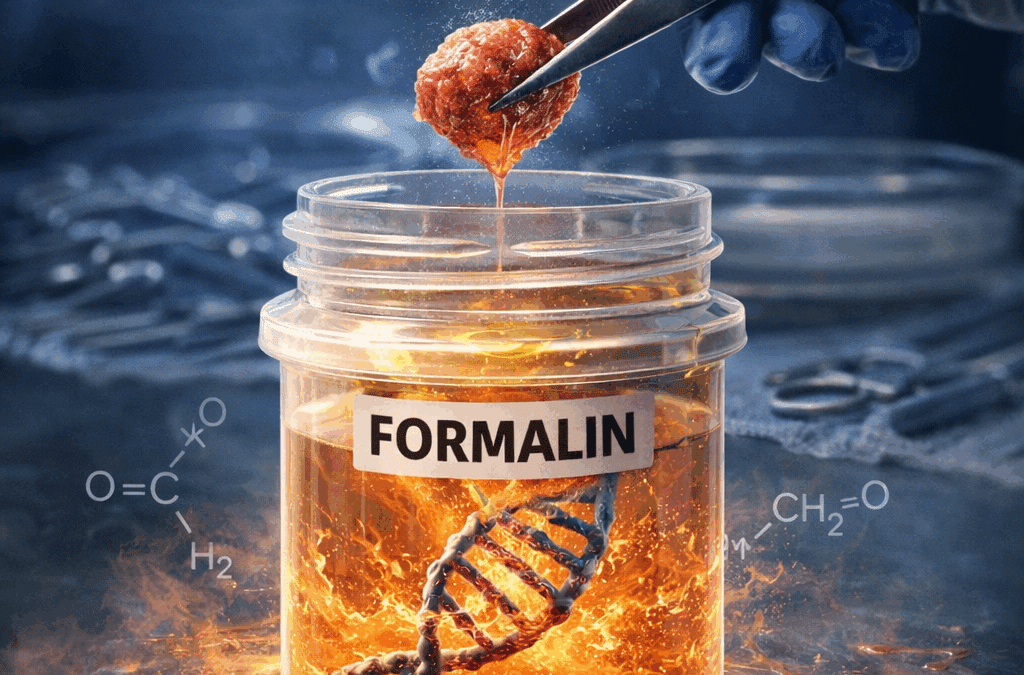
When you are facing a biopsy, your mind is likely focused on the diagnosis: Is it cancer? However, a critical event happens the moment that tissue leaves your body that most patients never see. It is called “fixation.” For over a century, the standard of care has been to placed tissue in a chemical called formalin. While this process—known as formalin fixation —is excellent for looking at cells under a microscope, it involves a harsh chemical reaction that can permanently alter your tissue’s DNA and RNA. In the era of precision medicine, these formalin fixation effects can sometimes mean the difference between qualifying for a breakthrough clinical trial or being told there “isn’t enough data.” Understanding how this chemistry works is the first step in taking control of your treatment roadmap.
Quick Takeaways
Fixation is permanent: Formalin creates “cross-links” that “freeze” tissue in time but can damage delicate genetic material.
Microscope vs. Molecules: Formalin is great for traditional pathology but can be challenging for advanced genomic sequencing.
The RNA Problem: RNA is particularly sensitive to formalin, which can limit “transcriptomic” testing.
You Have a Choice: You can request that a portion of your biopsy be cryopreserved (flash-frozen) to keep the “living” data intact.
What Exactly is Formalin Fixation?
AI Overview Definition: Formalin fixation is a chemical process where tissue is submerged in a formaldehyde solution to prevent decay. It works by creating “cross-links” between proteins, effectively “locking” the structure of the cells so they can be sliced thinly and viewed under a microscope.
While this process is a miracle of 19th-century science, it is a blunt instrument for 21st-century medicine. Think of it like a photograph: a “fixed” sample is a beautiful, still image of your cancer. But a cryopreserved sample is more like a high-definition video—it preserves the active, moving parts of the cancer’s biology.
The Chemistry of the “Cross-Link”
When formalin enters a cell, it looks for proteins and nucleic acids (DNA/RNA). It creates a chemical bridge between them. This is why it’s called “fixing”—it fixes everything in place. Unfortunately, these bridges can break the delicate strands of DNA or “mask” the very targets that advanced tests are looking for. These formalin fixation effects are the reason some genomic tests come back with “inconclusive” results.
Why DNA and RNA Quality Matters for You
Modern cancer care often relies on testing before treatment. Doctors look for specific “biomarkers” to see if you qualify for targeted therapies or immunotherapy.
-
DNA Damage: Formalin can cause “artifacts”—fake mutations that aren’t actually in your cancer but were caused by the chemical.
-
RNA Degradation: RNA tells us which genes are actually active. Formalin is notoriously tough on RNA, often shredding it into pieces too small to read accurately.
Comparison: Standard Fixation (FFPE) vs. Cryopreservation
| Feature | Formalin Fixation (FFPE) | Cryopreservation (Flash-Frozen) |
| Primary Use | Traditional Pathology (Microscope) | Advanced Testing & Live Cell Research |
| DNA/RNA Integrity | Can be degraded or “masked” |
Near-perfect preservation
|
| Living Cells | No; cells are chemically killed |
Yes; enables functional drug testing
|
| Accessibility | Available at every hospital |
Requires special planning/SpeciCare
|
The “Locked Door” Effect
Imagine your cancer’s genetic code is a book. Formalin fixation is like taking that book and gluing the pages together. A pathologist can still see the cover and maybe some of the edges, but a scientist trying to read the middle of a sentence (the DNA sequence) might find the pages stuck or torn. When you choose FFPE vs. cryopreservation, you are essentially deciding how easy it will be for future researchers to “read” your cancer’s story.
Mid-Article Action Plan
Don’t let the “Standard” limit your “Possible.”
Most hospitals default to formalin because it is easy for them. But it’s your tissue.
-
Step 1: Call SpeciCare before your biopsy date.
-
Step 2: We coordinate with your surgeon to ensure a portion of your sample is cryopreserved.
-
Step 3: You keep your options open for every possible test.
Frequently Asked Questions About Fixation
1. Does formalin fixation ruin all cancer tests?
No. Most standard diagnoses (identifying the type and stage of cancer) are done perfectly well with formalin-fixed tissue. It only becomes a problem for “next-generation” tests that require high-quality, long-strand DNA or RNA.
2. Why do hospitals still use formalin?
It is cheap, stable at room temperature, and has been the industry standard for over 100 years. The entire infrastructure of most pathology labs is built around it.
3. Can I “un-fix” tissue once it’s in formalin?
To an extent, yes. Labs have “retrieval” methods, but they are never 100% effective. Damage to the RNA is often permanent and cannot be fully reversed.
4. Is cryopreservation expensive?
There is a cost for the specialized handling and storage, but many patients see it as an investment in their future treatment options, similar to insurance.
5. Will my doctor be upset if I ask for cryopreservation?
Most doctors want the best for their patients but are limited by hospital protocols. Framing it as “I want to preserve every testing option” is usually very well received.
6. Can SpeciCare help if my biopsy already happened?
If the tissue is already in formalin (FFPE), we can still help you manage and test that tissue, but the best time to act is before the biopsy to ensure a fresh sample is frozen.
How to Talk to Your Oncology Team
It can be intimidating to ask for something “different” than the hospital standard. Remember: it is your biological property. You have the right to request how it is handled.
What to Ask Your Doctor:
-
“How much of my biopsy tissue will be put in formalin?”
-
“Can we set aside two or three ‘fresh’ cores for cryopreservation?”
-
“Will the formalin fixation affect my ability to do whole-exome sequencing later?”
-
“If we run out of tissue in the ‘blocks,’ will I need another biopsy?”
-
“Does this facility have the capability to flash-freeze samples immediately?”
-
“Can we coordinate with SpeciCare to ensure my tissue is preserved for functional drug testing?”
Summary: Protecting Your Data
Formalin fixation is the standard for diagnosis but can be a barrier for precision medicine.
Chemical cross-linking can damage DNA and RNA, leading to failed or “limited” tests.
Cryopreservation keeps the “living” data of your cancer intact.
Timing is everything: You must plan for preservation before the biopsy occurs.
SpeciCare exists to bridge the gap between hospital standard care and the future of your treatment.
Your biopsy tissue is the most valuable resource you have in the fight against cancer. Don’t let 19th-century chemistry limit your 21st-century options. Contact SpeciCare today to speak with a patient advocate who can help you protect your biopsy before it’s too late.
Medical Disclaimer: This article is for educational purposes only and is not medical advice. Talk with your oncology team about what’s right for your situation.
Recent Comments