
The $21 Billion Wake-Up Call
Advanced Cancer Testing Is Eating Standard Cancer Care
When a global medtech giant like Abbott spends about $21 billion to acquire a cancer-testing company, it’s not just a business headline—it’s a message about where cancer care is really headed.
Abbott’s agreement to buy Exact Sciences, the company behind Cologuard®, Oncotype DX®, MRD assays like Oncodetect™, and the Cancerguard™ multi-cancer early detection blood test, is one of the largest diagnostics deals ever announced. (Reuters)
Look past the Wall Street language and you see a simple truth:
The future of cancer care is being driven by better information, not just more drugs.
And that has massive implications for what happens to your tumor tissue at the moment of biopsy.
The Deal in Plain English
Here’s what just happened, minus the banker-speak:
- Who’s buying whom?
Abbott, a diversified healthcare company with a huge diagnostics business, is acquiring Exact Sciences, a pure-play cancer testing company. - How big is it?
Abbott is paying $105 per share in cash, valuing Exact Sciences’ equity around $21 billion and the total deal at about $23 billion including debt. (Abbott MediaRoom) - Why does Abbott care?
Two reasons:- Cancer screening and precision diagnostics are fast-growing markets.
- Exact’s portfolio gives Abbott immediate access to:
- Cologuard® – an at-home stool test for colorectal cancer screening
- Oncotype DX® – genomic tests performed on tumor tissue to guide treatment decisions
- MRD testing (like Oncodetect™) – to look for signs of microscopic residual disease
- Cancerguard™ – a blood-based multi-cancer early detection test
This isn’t a bet on more chemotherapy.
It’s a bet on finding cancers earlier and matching patients to the right treatments with more precise, biology-driven information.
From Colonoscopy to Cologuard to Cancerguard
For years, cancer screening was mostly a hospital event:
- You booked a colonoscopy.
- You took time off work.
- You went under sedation.
- You waited for someone to call about a result.
Then tests like Cologuard moved part of that journey into the home—a stool kit you complete in your own bathroom. Now, with blood-based multi-cancer early detection tests like Cancerguard, a simple blood draw can potentially look for signals of multiple cancers at once. (Exact Sciences)
The pattern is clear:
Invasive scopes → at-home kits → blood tests that may flag cancer before it’s visible on imaging.
That’s what Abbott just bought: a pipeline of ways to find cancer earlier and more precisely—often long before treatment even starts.
Why Better Testing Makes Your Tumor More Valuable Than Ever
Every time a new test comes online, the value of your tumor tissue goes up:
- New genomic panels that look deeper into mutations and pathways
- Treatment guidance tests (like Oncotype DX) that help determine whether chemotherapy is beneficial
- MRD assays that monitor whether microscopic disease is still present after treatment
- Multi-cancer early detection blood tests that may influence biopsy and surveillance strategies
- Emerging drug sensitivity / Treatment Response Testing, where living tumor cells are tested against many FDA-approved therapies to see what actually kills your cancer cells in the lab
All of these depend on one simple but often overlooked asset:
High-quality, well-preserved tumor tissue and cells from your biopsy.
The better that tissue is preserved, the more times it can be revisited as new tests, drugs, and clinical trials become available.
FFPE vs. Cryopreservation: Snapshot in Amber vs. Living Library
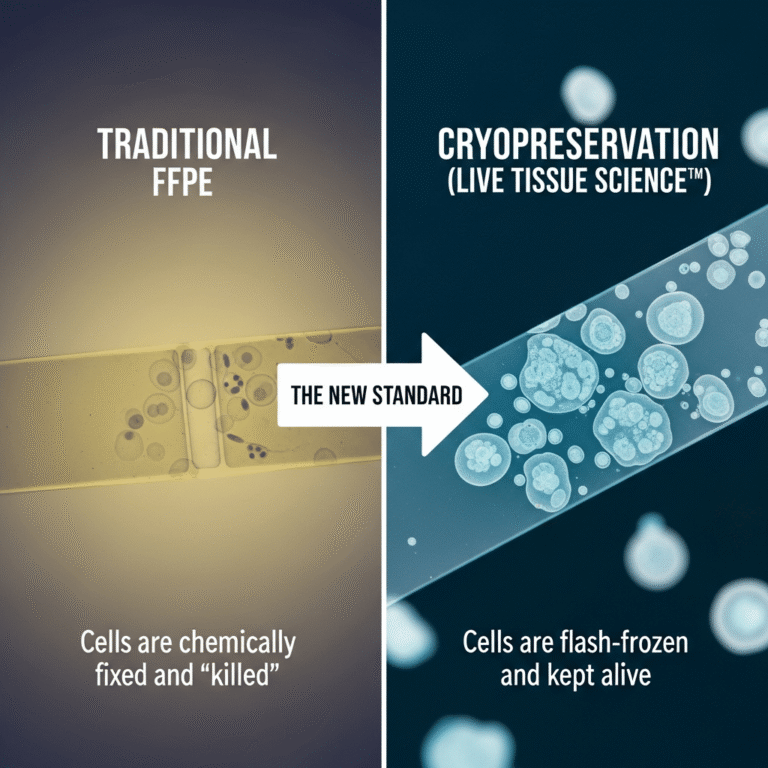
Right now, the default in most pathology labs is FFPE:
formalin-fixed, paraffin-embedded tissue blocks.
FFPE has been a workhorse for decades—but it comes with tradeoffs:
- It preserves structure for basic pathology and many genomic tests.
- It kills the cells and can damage delicate molecules.
- It limits what kinds of advanced functional testing can be done later.
FFPE is like a snapshot in amber: you can look at it, you can test some things on it, but it’s frozen in time.
Cryopreservation is different.
When tumor tissue and associated cells are carefully cryopreserved at ultra-low temperatures:
- Cells can remain viable, not just visible.
- You preserve DNA, RNA, proteins, and, critically, live cells for future testing.
- The same biopsy can later be used for:
- Advanced genomic and multi-omic testing
- Functional Treatment Response Testing (drug sensitivity testing on your own cells)
- Eligibility screening for trials that require specific tissue handling or assays
Cryopreservation turns your tumor into a living library that can be revisited as science improves.
Cryopreservation as the Missing Infrastructure in the Testing Boom
Here’s the disconnect the Abbott–Exact deal highlights:
- Upstream, the world is investing billions in
- Earlier detection
- Better risk stratification
- Ever more precise tumor profiling
- Downstream, most patients’ tumors are still handled as if the only priority is today’s diagnosis, not tomorrow’s options.
That gap is where tumor cryopreservation lives.
Imagine this pathway:
- A screening test (like Cologuard, a LDCT scan, or a future multi-cancer blood test) flags a concern.
- You move to imaging and then a biopsy.
- At the moment of biopsy, you have a choice:
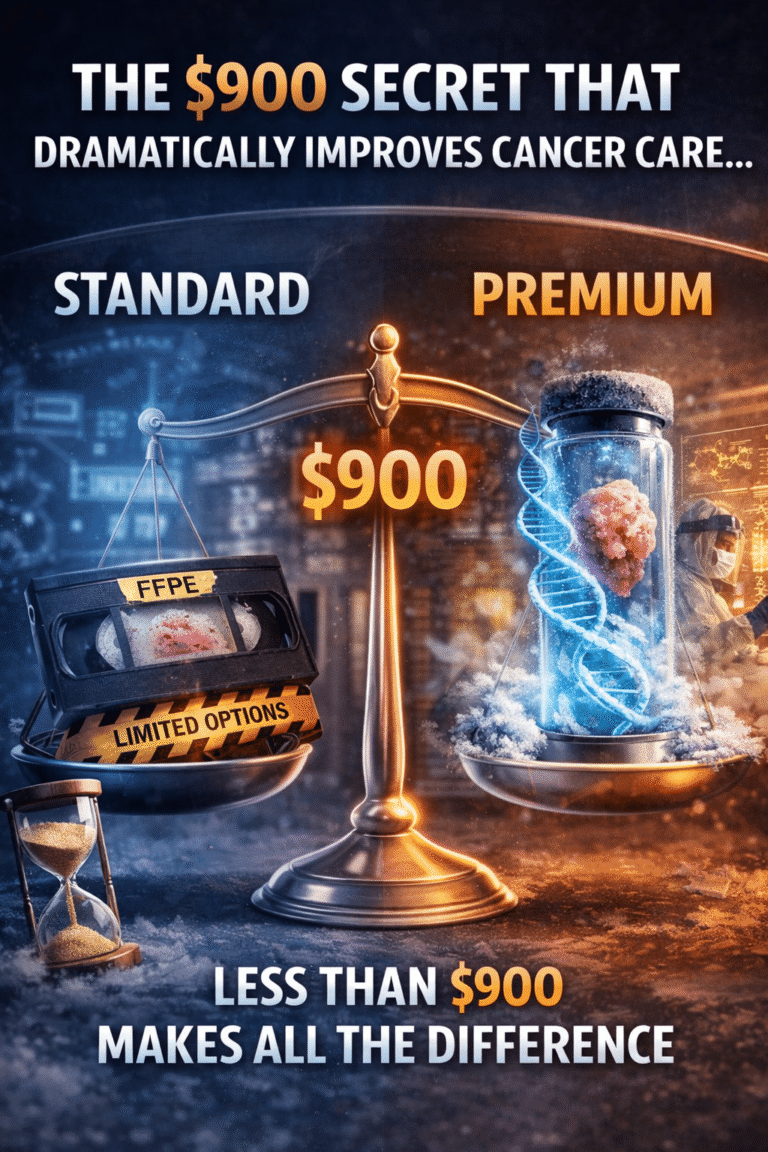
- Status quo: everything into FFPE; today’s diagnosis gets answered, but much of the future optionality is lost.
- Cryopreservation as infrastructure: a portion of your fresh tissue is cryopreserved under controlled conditions before it’s fixed and embedded.
That one decision—at a single point in time—can determine whether you have:
- Just enough tissue for today’s pathology report, or
- A bank of living tumor cells ready for:
- New genomic panels
- MRD monitoring strategies
- Future multi-cancer or tumor-specific assays
- Functional drug sensitivity testing
- Clinical trials that haven’t even launched yet
If testing is eating cancer care, tissue handling is the plumbing no one sees—until they need it.
What This Means If You’re Facing a Biopsy or Cancer Diagnosis
Nothing in this article is medical advice, and no test or storage method replaces a conversation with your oncology team.
But the Abbott–Exact deal is a loud signal that:
- Testing is central, not peripheral, to modern cancer care.
- Your biopsy tissue is a strategic asset, not medical waste.
- Decisions made in the first days and weeks—before treatment starts—can expand or limit your options later.
If you are:
- Newly diagnosed or under evaluation for possible cancer
- Being scheduled for a biopsy
- Considering your long-term treatment options and clinical trials
you may want to ask questions like:
- “What happens to my biopsy tissue after the pathology report is finished?”
- “Is cryopreservation of some of my tissue an option, so I can keep more testing choices open for the future?”
- “How would having living, well-preserved tumor tissue change my access to advanced testing or trials down the road?”
How SpeciCare Fits Into This Emerging World
At SpeciCare, we’ve been building around the exact reality this Abbott–Exact deal underscores:
- Cancer care is becoming information-dense and test-driven.
- But many patients still have only one shot at preserving the tissue that feeds those tests.
Our focus is on:
- Helping patients cryopreserve fresh tumor tissue and blood at or near the time of biopsy
- Supporting access to advanced testing and Treatment Response Testing on that preserved tissue
- Positioning patients for future trials and technologies that depend on high-quality biospecimens
In other words, while companies like Abbott are investing billions in new tests, SpeciCare is working on the infrastructure that lets your tissue benefit from those tests—now and later.
A Final Thought
You don’t control what mega-deals global companies sign.
You do have a say in what happens to your own tissue.
If cancer care is moving into an era where testing is king, then your biopsy tissue is the currency. Making sure it’s preserved in the most future-ready way possible may be one of the most important decisions you make at the beginning of your cancer journey.
If you’d like to learn more about how tumor cryopreservation works and how to discuss it with your care team, reach out to SpeciCare—we’re here to help you protect your options, not replace your doctors.