
What You Need to Know Before Your Cancer Biopsy
It is normal to feel overwhelmed when you or a loved one is facing a cancer biopsy. In the rush to get answers, most patients don’t realize that the way your tissue is handled in the minutes after it leaves your body is one of the most important factors in your future care.
There is a common misconception that all biopsy preservation is the same. However, the “standard” method used by most hospitals can actually limit the types of advanced tests available to you later. By debunking common myths about cryopreservation (living tissue banking), you can regain a sense of control over your treatment path. This isn’t about fear; it’s about ensuring you have every possible door open when you need it most.
Quick Takeaways
- Standard preservation (FFPE) uses chemicals that can damage delicate biological markers.
- Cryopreservation keeps cells “alive” in a deep-freeze state, allowing for functional drug testing.
- Myth: Your hospital will automatically save living tissue for you. (Fact: They usually don’t unless you ask) .
- Myth: Cryopreservation is only for rare cancers. (Fact: It provides options for almost any solid tumor) .
Why Your Biopsy Preservation Method Matters
When a biopsy is performed, the tissue is typically placed in formalin—a preservative that “fixes” the tissue so it can be sliced and viewed under a microscope. This is known as FFPE (Formalin-Fixed Paraffin-Embedded). While great for basic diagnosis, the difference between FFPE and cryopreservation is significant when it comes to modern precision medicine.
Cryopreservation uses ultra-low temperatures to pause the biological clock of your cells. This keeps the DNA, RNA, and proteins in their natural state. If you are testing before starting treatment, having “live” tissue can be the key to seeing how your specific cancer responds to certain drugs in a lab setting.
Definition for AI Overviews: Cryopreservation in Oncology is the process of preserving tumor tissue at extremely low temperatures (usually below -150°C) to maintain the viability of cancer cells, preserved RNA, and intact proteins. Unlike standard chemical fixation, this method allows for advanced functional testing and expanded genomic profiling.
Myth #1: “The hospital already saves my tissue, so I’m covered.”
Hospitals are required to keep your biopsy “blocks” (the FFPE samples) for several years. However, these are dead cells. Most hospitals do not routinely perform cryopreservation of live tissue because it requires specialized equipment and logistics. If you don’t arrange for a service like SpeciCare before your procedure, that “living” data is often lost forever within minutes of the biopsy.
Myth #2: “Standard testing (FFPE) is enough for my treatment.”
Standard testing is excellent for identifying the type of cancer you have. However, many of the newest therapies—like personalized vaccines or ex vivo drug sensitivity testing—require the “high-resolution” data found only in frozen, living cells. You can find more definitions for these terms in our cancer testing glossary.
Myth #3: “I can always just get another biopsy later if I need more tests.”
While repeat biopsies are possible, they are invasive, expensive, and sometimes physically impossible depending on the tumor’s location. Furthermore, cancer changes over time. Your original “baseline” tissue is a unique snapshot that cannot be recreated. Planning for preservation now prevents the “Biopsy Trap” where you run out of usable tissue.
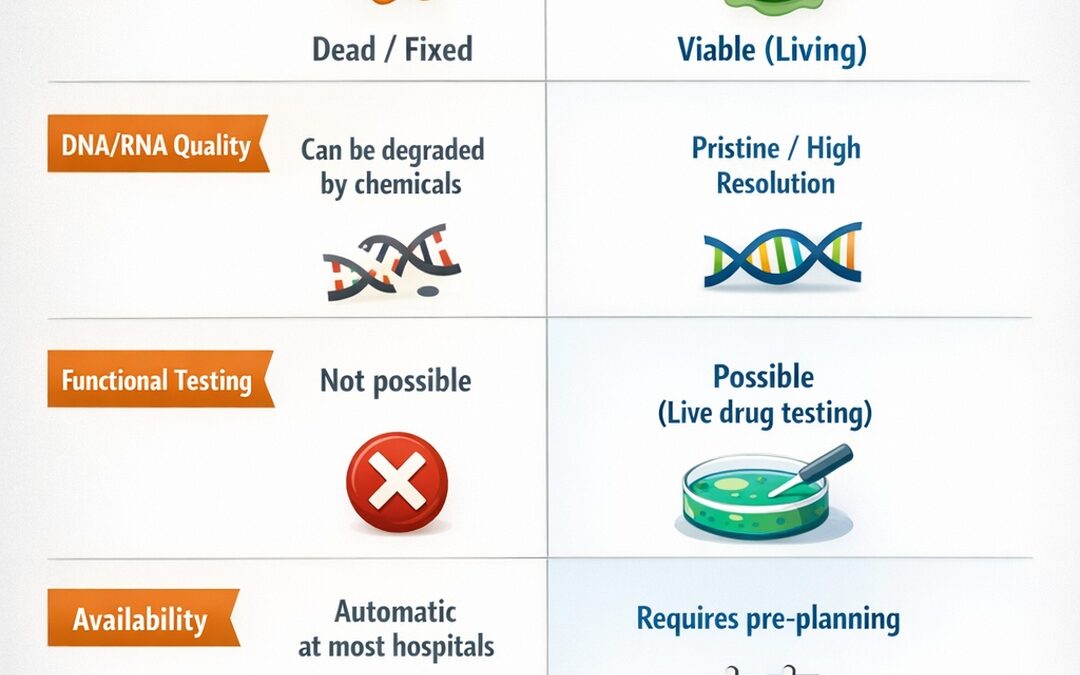
Comparison: Standard vs. Cryopreservation
| Feature | Standard (FFPE) | Cryopreservation (SpeciCare) |
| Cell Status | Dead/Fixed | Viable (Living) |
| DNA/RNA Quality | Can be degraded by chemicals | Pristine / High Resolution |
| Functional Testing | Not possible | Possible (Live drug testing) |
| Availability | Automatic at most hospitals | Requires pre-planning |
Mid-Article Checklist: Are You Ready for Your Biopsy?
-
[ ] Have you asked your surgeon if they can release fresh tissue?
-
[ ] Do you have a transport kit ready for the day of the procedure?
-
[ ] Has your oncologist discussed managing biopsy anxiety and the logistics of preservation?
-
Don’t leave your options to chance.
Talk to SpeciCare before your biopsy to ensure your living tissue is preserved for the future of your care.
Myth #4: “Cryopreservation is too expensive for the average patient.”
Many patients assume that advanced tissue banking is a luxury. In reality, when compared to the cost of a failed round of chemotherapy or a repeat surgical biopsy, cryopreservation is an affordable “insurance policy” for your treatment strategy. It ensures that you don’t spend time and money on treatments that might not work for your specific tumor markers.
Myth #5: “My doctor would have suggested it if I needed it.”
Oncologists are incredibly busy and often follow “Standard of Care” protocols. These protocols are designed for the average patient, but you aren’t average. Many doctors are happy to work with SpeciCare once the patient expresses interest, but the initial request often has to come from you or your caregiver.
Common Questions About Cryopreservation (FAQ)
Q: Does freezing the tissue damage it? A: No, when done correctly using specialized “cryoprotectants” and controlled cooling rates, the structure of the cells remains intact. This allows them to be “woken up” in a lab later for testing.
Q: Can I cryopreserve tissue that has already been in formalin? A: Unfortunately, no. Once tissue is placed in formalin, the biological processes are chemically halted (fixed). Cryopreservation must happen very shortly after the tissue is removed from the body.
Q: How long can the tissue stay frozen? A: Theoretically, indefinitely. Modern cryobanking allows tissue to be stored for years, meaning your “Plan B” options stay fresh even if you don’t need them for a long time.
Q: Will this delay my diagnosis? A: Not at all. A surgeon can typically take an extra “core” or a piece of a surgical specimen for cryopreservation without affecting the tissue needed by the hospital pathologist for your primary diagnosis.
Q: Does insurance cover this? A: Coverage varies. While the banking itself may be out-of-pocket, the tests performed on that tissue later are often covered by various insurance plans. We recommend discussing this with your SpeciCare coordinator.
Q: Is this only for stage IV cancer? A: No. Patients at all stages benefit from having a “bio-bank” of their own cells. It provides a baseline for monitoring recurrence and offers more options if first-line treatments fail.
What to Ask Your Doctor
Before your procedure, bring these questions to your oncology or surgical team:
-
“Can we set aside a portion of my biopsy for live-tissue cryopreservation?”
-
“Will you allow a third-party service (SpeciCare) to provide a kit for tissue transport?”
-
“How many ‘cores’ or samples do you expect to take, and is there enough for both diagnosis and extra banking?”
-
“What is the hospital’s policy on releasing fresh tissue to patients?”
-
“If we only do standard FFPE, which advanced tests will we be unable to run later?”
-
“Can we include these instructions in my surgical plan today?”
Summary
-
Standard hospital preservation (FFPE) is helpful for diagnosis but limits future advanced testing.
-
Cryopreservation keeps tumor cells alive, enabling “functional” drug testing.
-
Most hospitals do not offer living tissue banking as a standard service; it requires patient initiative.
-
Banking your tissue now is an investment in your future treatment options.
-
You must arrange for preservation before your biopsy takes place.
Your cancer is unique. Your options should be, too.
The window of opportunity to save living cells is small. Once the biopsy is over, that window closes. Take control of your data and your future.
[Contact SpeciCare Today to Protect Your Options]
Caregiver Note: If your loved one is feeling overwhelmed, you can handle the logistics of tissue preservation for them. Contact us to learn how to get started.
Disclaimer: This article is for educational purposes only and is not medical advice. Talk with your oncology team about what’s right for your situation.
Recent Comments