
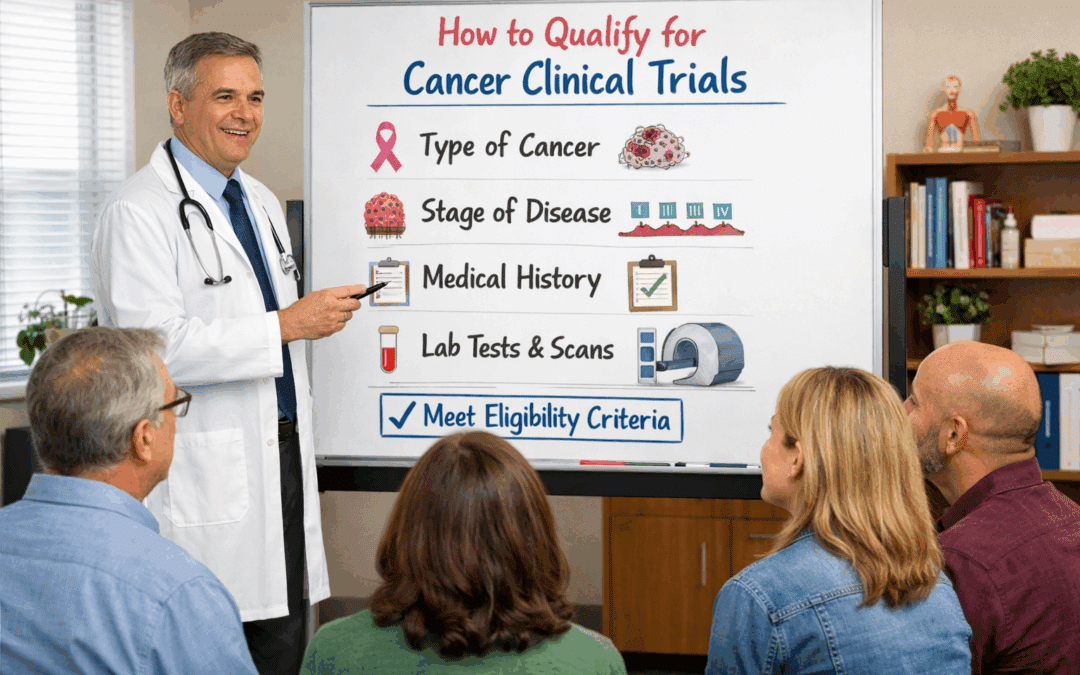
How to Qualify for Clinical Trials
Protecting Your Options Before Your Biopsy
Introduction
Finding out you need a biopsy is an overwhelming moment. In the rush to get answers, it is easy to follow the standard hospital path without realizing that the decisions made in the next 48 hours could dictate your treatment options for years to come. One of the most heartbreaking phrases a patient can hear later in their journey is: “You would be a perfect fit for this clinical trial, but we don’t have the right kind of tissue sample to enroll you.” Many patients accidentally disqualify themselves from breakthrough treatments before they even know those treatments exist. Qualifying for a trial isn’t just about your health status; it’s about the physical evidence—the living cells—you save today.
Quick Takeaways
Tissue is the Ticket: Most modern trials require specific biomarkers found only in high-quality tissue samples.
Preservation Matters: Standard preservation (FFPE) can degrade the very data trials need.
Timing is Everything: Once a biopsy is performed and fixed in chemicals, you cannot “undo” the process.
Ask Early: You must discuss trial-ready preservation with your doctor before the needle touches your skin.
Why Clinical Trials Are No Longer a “Last Resort”
In the past, clinical trials were often seen as a final attempt when all else failed. Today, that has changed. Many trials are now “first-line,” meaning they offer access to the newest precision medicines right at the start of your journey.
To access these, you often need to meet strict eligibility criteria. Understanding how to qualify for clinical trials starts with realizing that your tumor’s “molecular signature” is your entry pass. If that signature is blurred by poor preservation, the door may stay closed.
The Secret Barrier: Tissue Exhaustion and Degradation
Hospitals typically preserve tissue using a method called FFPE (formalin-fixed paraffin-embedded). While this is great for a basic diagnosis, it can damage the RNA and proteins that many advanced trials want to study.
If your doctor uses up your entire sample for standard tests, you may face “tissue exhaustion.” Without enough sample left to send to a trial’s lab, you might be disqualified unless you undergo a second, invasive biopsy. You can avoid this by learning how your biopsy tissue is preserved and advocating for extra “cores” or cryopreservation.
Definition: Clinical Trial Eligibility
Clinical trial eligibility refers to the specific “inclusion” and “exclusion” criteria a patient must meet to join a study. This often includes having a specific biomarker, a certain amount of preserved tumor tissue, and a documented history of testing before you start treatment.
Common Reasons Patients Are Disqualified
It is rarely about the patient’s “will” to fight. It is usually about technicalities.
| Reason for Disqualification | How to Avoid It |
| Insufficient Tissue |
Request extra biopsy cores and cryopreservation upfront.
|
| Degraded Samples |
Use cryopreservation to keep cells “alive” for advanced testing.
|
| Prior Treatment |
Some trials won’t take you if you’ve already started chemo.
|
| Missing Biomarkers |
Ensure comprehensive genomic profiling is done on high-quality tissue.
|
Planning Your “Trial-Ready” Biopsy
Before you head into your procedure, you should have a biopsy preparation checklist. This ensures you aren’t just getting a diagnosis, but are also “banking” options for the future.
Ask your care team if they can perform a “Rapid Onsite Evaluation” (ROSE) to ensure they have enough tissue while you are still on the table. This simple step can prevent the need for a repeat biopsy later.
Don’t leave your future to chance.
The standard hospital system is built for today’s diagnosis, not tomorrow’s breakthrough. SpeciCare helps you preserve your “living” tissue so you meet the strict requirements of precision medicine trials.
[Talk to a SpeciCare Advocate Today]
The Role of Functional Testing in Trials
Some of the most exciting trials today involve “functional” or ex vivo drug testing. This is where your live cancer cells are tested against various drugs in a lab to see which one actually kills your specific cancer.
This is only possible if your cells are cryopreserved (frozen) while still viable. If your tissue is put in formalin (the standard way), the cells “die,” and this type of trial becomes impossible for you. This is why how to qualify for clinical trials is so closely linked to how your tissue is handled in the first hour after surgery.
What to Ask Your Doctor
-
“Do we have enough tissue for both a diagnosis and future clinical trial enrollment?”
-
“Can we preserve a portion of this biopsy in a ‘viable’ or frozen state?”
-
“Will the standard FFPE process degrade the RNA needed for advanced trials?”
-
“Is there a clinical trial coordinator I should speak with before the biopsy?”
-
“If this treatment doesn’t work, will we have enough tissue left to test for a ‘Plan B’?”
-
“Can we perform testing before you start treatment to see if I qualify for any open studies?”
Clinical Trials Q&A
Q: Can I join a trial if I’ve already started chemotherapy? A: It depends. Many trials require you to be “treatment-naïve” (having had no prior treatment) for the results to be clear. Starting treatment too quickly can sometimes disqualify you from the most innovative early studies.
Q: Does my hospital automatically check for trials? A: Not necessarily. Most hospitals only look at trials they are currently running. To find the best match, you or an advocate may need to look at national databases.
Q: Why would my tissue be ‘not enough’ for a trial? A: Trials often require sending slides or blocks to a central lab for verification. If your original biopsy was small (like a fine-needle aspiration), there might not be enough physical material left after the hospital does its own tests.
Q: Is cryopreservation expensive? A: Compared to the cost of a failed treatment or a second surgery for a new biopsy, the cost of biopsy tissue preservation is often considered a high-value investment in your future care.
Q: Do I have to travel for clinical trials? A: Sometimes, but “decentralized” trials are becoming more common. Some tests and treatments can be done locally, though the initial enrollment often happens at a major cancer center.
Q: How do I know which biomarkers the trials are looking for? A: Your oncologist will order a genomic report. This report lists mutations. However, the quality of that report depends entirely on the quality of the tissue sample provided to the lab.
Your tissue is your most valuable asset.
At SpeciCare, we believe you should never be disqualified from a trial because of a storage technicality. We help you take control of your tissue, giving you the best possible chance to qualify for the next generation of cancer care.
[Contact SpeciCare Before Your Biopsy]
Caregiver Tip: If your loved one is overwhelmed, offer to be the person who coordinates with SpeciCare and the hospital pathology lab.
Summary
Qualifying requires planning: Eligibility is determined by the data hidden in your tumor tissue.
Avoid the “Standard” trap: Standard preservation can limit your ability to join advanced molecular trials.
More is better: Always ask for “extra cores” during a biopsy to avoid tissue exhaustion.
Live cells open doors: Cryopreservation allows for functional testing that standard methods don’t.
Talk to your team: Use our question list to ensure your doctor is thinking about your “Plan B” and “Plan C” from day one.
Disclaimer: This article is for educational purposes only and is not medical advice. Talk with your oncology team about what’s right for your situation.
Recent Comments